Friday, April 29, 2011

A three sisters garden


Today was a chance to join social studies and gardening. Mrs. Lanes' first grade class planted a classic Native American garden - a three sisters garden. Rather than planting crops in monocultural rows - corn, beans, and squash all off in separate fields - Native Americans planted all three "sisters" in mounds. These three crops have a wonderful relationship- the corn provides support for the beans, the beans provide nitrogen for the corn, the squash shade the earth and keep it cool and suppress the weeds.

I was going to plant seed corn, but then learned I had to wait 2 weeks for it to come up before I planted the beans. A quick visit to our wonderful local feed and seed/hardware/allsorts store, Griffs solved the problem, 4" high Silver Queen starts. We enriched the soil with mushroom compost and made our mounds. Then 18 very excited first graders worked in shifts to plant the sisters. We planted the corn oriented to the North, South, East and West as Cherokee would have. Then each corn plant got two bean seed sisters and each mound will have 4 pumpkin seeds. I bought cheap seeds and there were only a few seeds in each packet so I shall have to back and sow some more tomorrow. I lined the garden with sunflowers. I'm not sure how successful this will be because it is smaller than Renee's Garden suggests is the minimum size - 10' x 10', but fingers crossed.


Some of the Native American stories about the three sisters are located at the Bird Clan of East Central Alabama website.

Friday, April 22, 2011

Spring activity

Ms. Lanes class have green fingers! Their seeds came up like gang-busters. And, thanks to Ms. Fran they survived and thrived through spring break.


Harvest!


Wednesday, March 23, 2011

Spring!

I can't believe it is almost late March! The daffodils are up and well into flower in the garden. Use of the garden has increased, Last Friday I went out with Ms. Lanes first grade class and we encountered two other classes using the space as an outdoor classroom- magic! We started seeds
for the Rainbow Garden: Red salvia, yellow and orange marigolds, oregano, blue cornflowers and purple basil. They sure do have green thumbs! Seeds were up by Tuesday!


Thursday, October 21, 2010

A new semester - the garden progresses

Long view of the garden showing the new benches set up and ready to use.


The addition of benches and tables with colorful umbrellas makes this a perfect place for classes to gather and work. Last time I was out with a first grade class a third grade class was discussing and measuring their shadows. The Grandparent luncheon was held in the hallway looking out onto the garden and some tables were set up actually in the garden. It was a lovely event! Notice the student tiles, framed and hung by the local Boy Scout troop, between the two windows on the right.


The first grade have been learning all about seeds and the parts of plants. They planted lettuce, spinach, carrots, onions and garlic. Everything is sprouting!
These are lettuce seedlings. The first grade garden is the Rainbow Garden, the red pineapple sage and the verbena are quite stunning now.

Saturday, May 22, 2010

The value of a garden to a school


I firmly believe that a garden can be a revolutionary learning tool for a school. When combined with discovery-based, inquiry focused lessons children will learn how to think- not just to regurgitate the "facts' you tell them. A garden focuses children in a wonderful way- they learn how to observe, create and analyze in an organic and unthreatening setting. I have been in the garden at PES when children have observed butterflies sipping nectar, have come face to face with a bee and learned how to deal with fear, and held a strawberry plant with a big fat ball of mud beneath it and asked with reverance- "can I hold that." They have discovered the difference between tomatoes and strawberries (really!) and that they can plant a bulb and it will come up in the spring. These(many) children are starved for someone to connect them to the natural world. It can be the canvas for many lessons from science to history to English language to math. The garden teaches them about the wonders of our world in our backyard, not just that wonders are "out there" "somewhere else" and that we have no control over them. In fact the lessons of the garden are that we can transform our world and make it a better place. From creating habitat for birds, catching glimpses of the resident rabbi,t or growing food for the local soup kitchen the children become active agents in solving national and international problems - this is learning beyond price..

Saturday, April 24, 2010

What's hidden in the Garden

See the eye-ball hidden in the grass? This is what was hidden in the garden when Mr. L.T. mowed.


Thank you Mr. L.T.!

Monday, April 19, 2010

Pendleton Elementary-News Flash

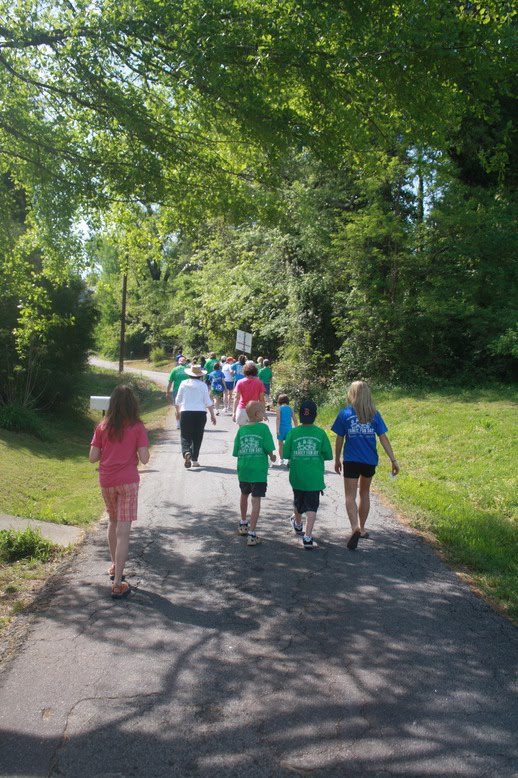
Pendleton Elementary teachers and students participated in the First Annual Health and Heritage Walk.
The two mile walk started and ended at the Keese Barn on West Queen Street. The heritage portion of the walk focused on the African-American experience as we visited local historic houses, churches, cemetery's and other African-American sites of interest.
Of the three local elementary schools, Pendleton had the largest contingent and was awarded a check for $200.00. It was a great deal of fun and we're all looking forward to next year's event.