Thursday, October 21, 2010

A new semester - the garden progresses

Long view of the garden showing the new benches set up and ready to use.


The addition of benches and tables with colorful umbrellas makes this a perfect place for classes to gather and work. Last time I was out with a first grade class a third grade class was discussing and measuring their shadows. The Grandparent luncheon was held in the hallway looking out onto the garden and some tables were set up actually in the garden. It was a lovely event! Notice the student tiles, framed and hung by the local Boy Scout troop, between the two windows on the right.


The first grade have been learning all about seeds and the parts of plants. They planted lettuce, spinach, carrots, onions and garlic. Everything is sprouting!
These are lettuce seedlings. The first grade garden is the Rainbow Garden, the red pineapple sage and the verbena are quite stunning now.

Saturday, May 22, 2010

The value of a garden to a school


I firmly believe that a garden can be a revolutionary learning tool for a school. When combined with discovery-based, inquiry focused lessons children will learn how to think- not just to regurgitate the "facts' you tell them. A garden focuses children in a wonderful way- they learn how to observe, create and analyze in an organic and unthreatening setting. I have been in the garden at PES when children have observed butterflies sipping nectar, have come face to face with a bee and learned how to deal with fear, and held a strawberry plant with a big fat ball of mud beneath it and asked with reverance- "can I hold that." They have discovered the difference between tomatoes and strawberries (really!) and that they can plant a bulb and it will come up in the spring. These(many) children are starved for someone to connect them to the natural world. It can be the canvas for many lessons from science to history to English language to math. The garden teaches them about the wonders of our world in our backyard, not just that wonders are "out there" "somewhere else" and that we have no control over them. In fact the lessons of the garden are that we can transform our world and make it a better place. From creating habitat for birds, catching glimpses of the resident rabbi,t or growing food for the local soup kitchen the children become active agents in solving national and international problems - this is learning beyond price..

Saturday, April 24, 2010

What's hidden in the Garden

See the eye-ball hidden in the grass? This is what was hidden in the garden when Mr. L.T. mowed.


Thank you Mr. L.T.!

Monday, April 19, 2010

Pendleton Elementary-News Flash

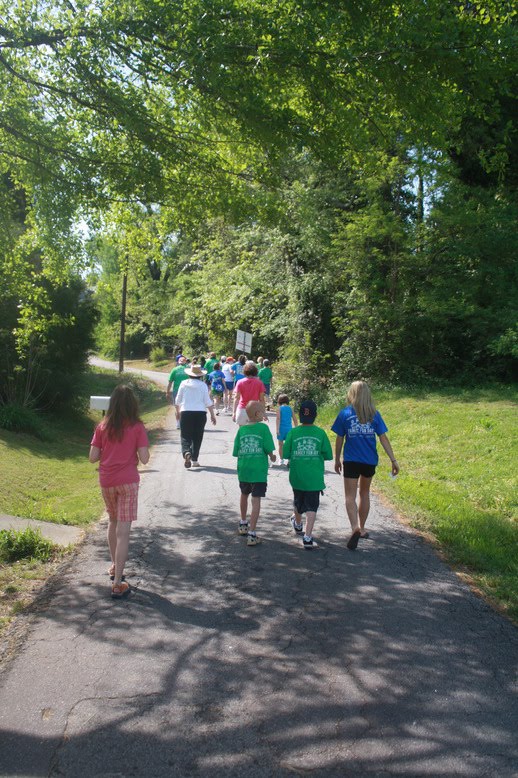
Pendleton Elementary teachers and students participated in the First Annual Health and Heritage Walk.
The two mile walk started and ended at the Keese Barn on West Queen Street. The heritage portion of the walk focused on the African-American experience as we visited local historic houses, churches, cemetery's and other African-American sites of interest.
Of the three local elementary schools, Pendleton had the largest contingent and was awarded a check for $200.00. It was a great deal of fun and we're all looking forward to next year's event.


Wednesday, February 17, 2010

Robin - Herald of Spring

Now is the time that we begin seeing flocks of Robins in this area. It is quite common to see groups of more than 100 on the ground, or flocking around holly trees. The science behind this event is fascinating. There is a close relationship between the robin, earthworm and average temperatures which can be explored by exercising scientific observation and analysis. Students who are interested in this science project should check out Journey North which explores this relationship in greater detail.

Tuesday, November 24, 2009

The power of Squidoo

Ohme, who has been a constant, unwavering supporter of the Memory Garden, has a fabulous squidoo lens about our progress and history. Check it out here
There are some fabulous comments and there have been visitors from all over the world. A really neat feature is her ability to generate Memory Garden momentos which you can buy on-line and a portion of the profits comes to the Garden- how cool is that! I have my eye on a snazzy water-bottle with the Memory Garden logo on and perhaps all my friends might get Memory Garden bags for Christmas - but shhhhh, don't tell!

Wednesday, November 18, 2009

Garden volunteer program announced ...

The Growing Garden

Greetings PES family -

We are pleased to announce that initial construction phase of the Memory Garden is complete! Each grade is now responsible for an garden area based on their specific state standards. Now it is time to move forward and use this exciting new space and we need your help!

Earth Explorers is a volunteer-run program to enable students to use the Garden as a classroom space. Environmentally based education has been shown to produce gains for students in science, social studies, language arts and mathematics. By engaging in hands-on investigations of the natural world students develop skills in problem solving, critical thinking and analysis. By connecting children to the natural world and real world activities, they improve in self-esteem and self-confidence. We want this for our children!


Can you help us with any of the following?

Earth Guardians : volunteers who support the physical development and growth of the garden. Green fingers are not a requirement! While students will be actively engaged in planting and growing in the garden, volunteers support this process. This is particularly true during the summer months when crops and produce planted in the spring will become a valuable teaching tool at the beginning of the school year. We hope to have two Earth Guardians for each grade. Volunteers attend a one hour orientation session. Volunteer service can take place outside school hours.

Earth Guides : volunteers who help provide outdoor education to our students through active engagement in well designed, nationally recognized curriculum. Earth Guides do not need any specialized knowledge or skills. Only curiosity, an appreciation for the natural world, and a desire to help children learn. Our initial goal is to meet with all students once a season for an hour long on-site field trip. Volunteers attend a two hour training session at the beginning of the school year, or beginning of the calendar new year. Volunteers need to be available during school hours.

Earth Angels provide in-kind and monetary donations to the Garden We are very lucky to have an excellent start to our garden. Family, friends, community businesses, and local granting agencies have provided substantial suppor to get us to this point. However, there are some items that would enhance the garden's potential for education, but which lie outside the school budget.


Volunteer Sign Up Sheet

Please sign and return to your child's teacher.


  • Name:

  • Phone:

  • Email:

Call or email Sue for more information: 646-9973 / carowatts@gmail.com


  • Earth Guardian - I am available- days & times


  • Earth Guide - I am interested in being a guide for grade (s) :

  • Please check one or more

5K – Sensory Garden

Sensory Walks

2nd – Butterfly Garden

Habitats: Monarch Watch

4th– Columbian Exchange

Social Studies Programs

1st – Rainbow Garden

Seasonal planting and growing activities.

3rd– Carolina Fence Grdn

Habitat: Cornell Feeder Watch.

5th Grade – Aquatic Life

Project Wild - Aquatic

6th Grade -Circle Grdn

Project Wild.


  • EarthAngel


I would like to donate

I would like to purchase


Magnifying lens (25) - $30.00

Bird Bath $25 each

Seeds

Clipboards (25) - $125

Sit-upons – (25) - $125

Bird Feeders $15 each

Plants – Please think of us when you divide your perennials this winter.

Bug box (10) - $20

Bird House $15 each

Small trees/shrubs

Butterfly nets (5) - $75

Bird seed $10

General fund - maintenance

Binoculars (6) - $120


We are also looking for sections of trees to be used as seating and as teaching tools. If you have recently felled a tree, please think of us.


This is only a partial list and prices are approximate.